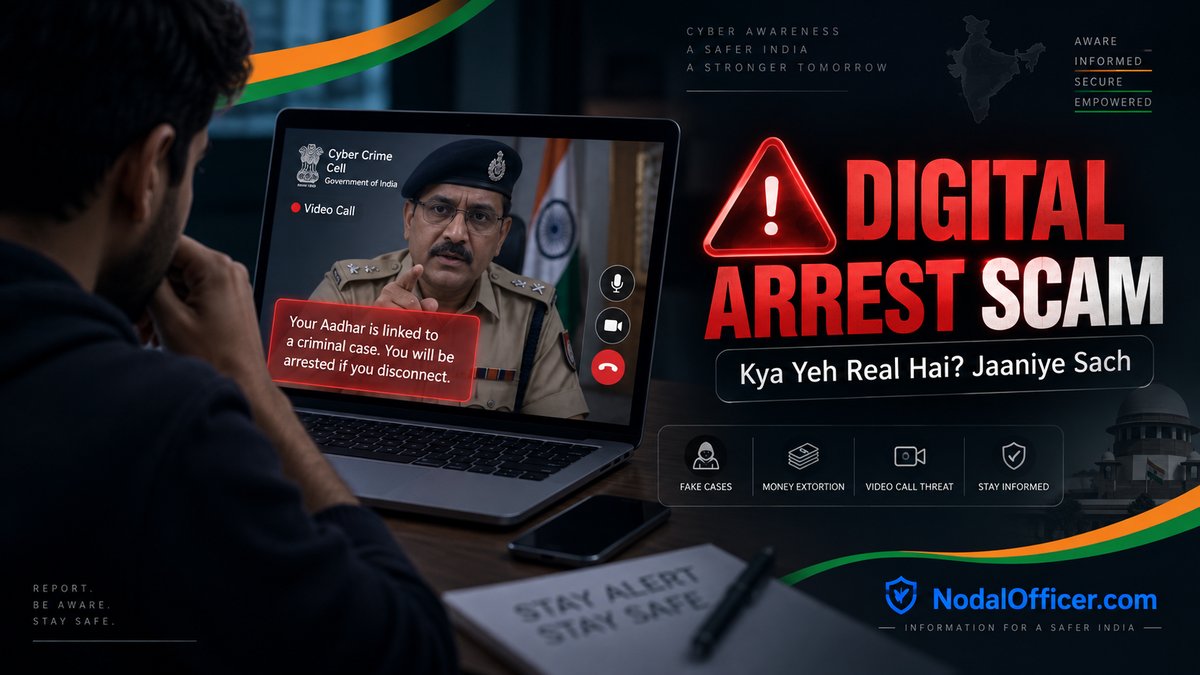
What is Digital Arrest Scam in India? How to Protect Yourself — 2026 Guide
What is Digital Arrest? — Quick Answer
Digital arrest does not exist in Indian law. It is a scam — 100%.
Criminals impersonate police officers, CBI agents, ED officials, or RBI representatives on a video call — using fake uniforms, AI-generated police station backgrounds, and forged court documents — then claim you are under “digital arrest” for crimes you never committed. The goal: extort lakhs or crores by keeping you isolated and terrified.
In 2026, digital arrest scams are India’s fastest-growing cyber fraud, with victims losing over ₹3,000 crore in January 2026 alone, according to the Indian Cyber Crime Coordination Centre (I4C).
Table of Contents
- Digital Arrest Meaning
- How the Scam Works — Step by Step
- Real Cases — How Much Has India Lost?
- 8 Warning Signs — It Is Always a Scam If…
- Is Digital Arrest Legal in India?
- What to Do When the Call Comes — 60 Seconds
- If Money Is Already Gone — Hour by Hour Action Plan
- Why You Need Your Bank’s Nodal Officer
- Who Gets Targeted the Most
- Frequently Asked Questions
Digital Arrest Meaning
| Term | Explanation |
|---|---|
| Digital Arrest | A fake threat where scammers pose as government officials on a video call and claim you are “digitally arrested” for a crime |
| Legal Status | Zero legal basis — not recognised under IPC, BNS, CrPC, or any Indian law |
| Real Purpose | Create panic and psychological pressure to force a money transfer |
| Primary Targets | Senior citizens, retired professionals, housewives, first-time smartphone users |
PM Narendra Modi (Mann Ki Baat, October 2024): “No government agency contacts citizens through WhatsApp or Skype for investigations. There is no such thing as digital arrest — it is only a fraud.”
How the Scam Works — Step by Step
Stage 1: The Setup Call
The victim receives a call — often a recorded message or an unknown number:
- “A parcel in your name was seized at Mumbai Customs — it contains drugs.”
- “Your Aadhaar number has been linked to a money laundering case.”
- “Eleven SIM cards are active in your name — a DoT investigation is underway.”
- “Your bank account has been flagged for illegal transactions.”
The victim panics. The caller says: “Stay on the line — I am connecting you to the Senior Investigation Officer.”
Stage 2: The Fake Officer Appears
A scammer appears on screen — in a police uniform, with the Ashoka Emblem behind them and a realistic police station background (AI-generated, indistinguishable from real in 2026). They present forged credentials and begin the “investigation.”
Stage 3: Isolation and Control
This is the core of the scam — psychological isolation:
- “This is a classified national security case — do not tell anyone.”
- “If you inform your family or lawyer, you will be treated as a co-accused.”
- “You must remain on camera 24 hours a day — this is your digital arrest.”
- “Disconnecting this call will trigger an immediate arrest warrant.”
Victims have been kept on camera for up to 14 days — alone, terrified, unable to think clearly.
Stage 4: The Money Demand
Fake documents are produced:
- Forged Supreme Court “Asset Seizure Orders”
- Fabricated FIR copies
- “Government Verification Account” details
Demands follow:
- “Transfer ₹5 lakh as a security deposit — your case will be closed.”
- “Pay ₹2 lakh court bail — it will be refunded within 48 hours.”
- “Your account must be ‘verified’ — transfer funds here first.”
Real Cases — How Much Has India Lost?
These are verified cases from 2024–2026:
| Victim | Location | Amount Lost |
|---|---|---|
| 92-year-old senior citizen | Delhi | ₹2 crore (recovered by Delhi Police) |
| Retired doctor couple | Delhi | ₹14 crore |
| Woman | Mangaluru, Karnataka | ₹1.80 crore |
| Homemaker | Karnataka | ₹3.16 crore |
| Elderly woman | Mangaluru | ₹3.09 crore |
| Professor | Indore, MP | ₹33 lakh lost → ₹26.45 lakh recovered |
| Victim (held on call 14 days) | Goa | ₹2.6 crore |
Karnataka alone: 641 cases, ₹109 crore total loss.
India-wide: Over ₹2,140 crore lost, 92,000+ complaints in 2024. In January 2026 alone, losses crossed ₹3,000 crore.
Supreme Court of India (February 2026) described these scams as “digital dacoity” and directed the Ministry of Home Affairs to form a special inter-departmental committee to address systemic gaps.
8 Warning Signs — It Is Always a Scam If…
Any one of these signs means the call is fraudulent — hang up immediately:
- Arrest via video call — No Indian law permits arrest through a phone or video call
- “Keep this secret” — Real law enforcement never asks victims to hide an investigation
- Money demanded — No legitimate government investigation demands payment upfront
- Stay on camera 24/7 — This is psychological coercion, not a legal procedure
- Do not contact family or lawyer — Real police never issue this instruction
- “Government Verification Account” — No such account exists in Indian law
- RBI or Supreme Court demanding money — The RBI has officially stated it never asks customers to transfer money or share OTPs
- AI-generated background — Scammers now use deepfake technology to create realistic-looking police stations on Zoom or Skype
Is Digital Arrest Legal in India?
No. Completely illegal — and non-existent in Indian law.
Neither the Indian Penal Code, the Bharatiya Nyaya Sanhita, CrPC, nor any other Indian legislation contains the concept of “digital arrest.”
No authority — Police, CBI, ED, Income Tax, RBI, TRAI, or the Supreme Court — can legally arrest anyone through a video call, WhatsApp, Skype, or Zoom.
RBI’s official position: The Reserve Bank of India never asks customers to transfer funds, share OTPs, or reveal banking credentials over a call.
NITI Aayog has officially classified digital arrest as a modern-day cyber scam in its published report Digital Arrest — The Modern Day Cyber Scam.
What to Do When the Call Comes — 60 Seconds
Call arrives → Hang up → Tell family → Verify → Call 1930Step 1 — Hang Up (Right Now)
Do not argue. Do not explain yourself. Do not ask questions. End the call.
Step 2 — Tell Someone Immediately
Tell any family member right away. The scam’s power lies in isolation — break it instantly.
Step 3 — Verify Independently
If you feel the need to check, find the agency’s official number on a .gov.in website and call them directly. Never use a number the caller gave you.
Step 4 — Do Not Transfer Any Money
Not one rupee. Not for “verification.” Not for “bail.” Not for any reason.
If Money Is Already Gone — Hour by Hour Action Plan
First 2 Hours — Most Critical
Call 1930 immediately (National Cybercrime Helpline — 24×7, free)
Keep this information ready:
- Transaction date, time, and amount
- UTR number / Transaction ID
- Fraudster’s phone number
- Recipient account details (if known)
The 1930 helpline operators alert banks directly — the fraudster’s account can be frozen within minutes of your call if you report fast enough.
Also call your bank:
- Tell customer care: “I have been a victim of cyber fraud — please reverse this transaction.”
- Email your bank’s Nodal Officer — this escalates faster than regular customer care
👉 Find your bank’s Nodal Officer email →
Within 24 Hours
File a complaint at cybercrime.gov.in (National Cyber Crime Reporting Portal — Ministry of Home Affairs):
- Click “Report Cyber Crime”
- Select “Financial Fraud”
- Fill in all details — what happened, when, transaction details
- Upload screenshots, bank statements, call recordings
- Save your Complaint ID — you will need it for follow-up
File an FIR at your local Cyber Crime Cell:
- Bring your Complaint ID and transaction proof
- Submit a written complaint — do not rely on verbal reports only
After 30 Days (If Bank Does Not Resolve)
RBI Integrated Ombudsman (Reserve Bank of India — official grievance portal):
- Email: crpc@rbi.org.in
- Attach your Complaint ID and all bank correspondence
Why You Need Your Bank’s Nodal Officer
When a cybercrime occurs, the Nodal Officer is the most powerful point of contact inside a bank:
- Account freeze and unfreeze decisions happen at Nodal Officer level
- They are a direct escalation above regular customer care
- Under RBI guidelines, fraud resolution is the Nodal Officer’s direct responsibility
- Response time after a Nodal Officer complaint is significantly faster
NodalOfficer.com maintains verified Nodal Officer contact details for 150+ banks, payment platforms, and tech companies across India:
👉 SBI Nodal Officer → 👉 HDFC Bank Nodal Officer → 👉 ICICI Bank Nodal Officer → 👉 Kotak Mahindra Bank Nodal Officer → 👉 Axis Bank Nodal Officer → 👉 Search all banks →
Who Gets Targeted the Most
Share this with your family — these groups are most frequently targeted:
- Senior citizens (60+) — less familiar with digital tools, more trusting of authority figures
- Retired government and bank employees — pension accounts are high-value targets
- Housewives — often home alone during daytime calls
- First-time smartphone users — unfamiliar with how video call scams work
- Educated professionals — doctors, engineers, professors — who feel the need to “verify first” and end up trapped
Quick Reference — Save This
| Situation | Action |
|---|---|
| ”Digital arrest” call received | Hang up immediately |
| Fake “officer” on video call | Disconnect — it is always fake |
| Demanded money for “government account” | Refuse completely |
| Money transferred — just now | Call 1930 (within 2 hours) |
| Filing online complaint | cybercrime.gov.in (within 24 hours) |
| Bank not responding | crpc@rbi.org.in — RBI Ombudsman |
| Need Nodal Officer contact | NodalOfficer.com |
This guide is published by NodalOfficer.com for public cybercrime awareness. Sources: Ministry of Home Affairs, Reserve Bank of India, NITI Aayog Digital Arrest Report, Supreme Court observations (February 2026), and verified news reports. If you are a victim, always use official channels — 1930 helpline, cybercrime.gov.in, and local police.